

The tile roofs on Dublin homes are built to last 50 years or more — but the systems underneath them are not. When a clay or concrete tile looks intact from the street, it can be hiding a cracked underlayment, a corroded flashing seal, or slow water intrusion that has been working its way into your decking and framing for months. By the time you see a stain on your ceiling, the damage is already done. The repair bill isn’t just for the tile anymore — it’s for the sheathing, the insulation, and sometimes the drywall below.
Wonderlin Roofing has been maintaining tile roofs on East Bay homes since 1992 — over 30 years of hands-on experience with the clay and concrete tile systems common throughout Dublin and Alameda County. We’re licensed under CA CSLB 642517, family-owned, and built on a single operating philosophy: prevention costs a fraction of replacement. Call (510) 288-8020 to schedule your inspection.
Tile Roof Maintenance In Dublin, CA – Protect Your Home Before Small Problems Become Major Repairs
In East Dublin, Dublin Ranch, and Positano, tile roofs are the dominant roofing system — and for good reason. They handle Alameda County’s climate better than most alternatives. Summer heat in the Tri-Valley regularly exceeds 100°F, diablo wind events put sustained lateral load on tile fasteners, and the concentrated winter rains that arrive between November and March deliver water at rates that expose every flashing weakness and drainage deficiency your roof has.
The vulnerability isn’t the tile itself. It’s what happens at the small-scale level: a single tile cracks from foot traffic during a cable installation. A flashing seal at the chimney separates after years of thermal expansion. An underlayment rated for 20 years has reached year 22. None of these announce themselves. Each one creates a pathway for water to bypass the tile system entirely and reach the decking, framing, and, eventually, the interior of your home.
The cost difference between a proactive tile roof maintenance visit and the structural repair that follows an untreated leak is not small. A maintenance visit that catches a cracked tile and reseals a chimney flashing might run $400–$800. The same leak left for two rainy seasons can produce $5,000–$15,000 in decking, insulation, and drywall repair — none of which is covered by standard homeowners insurance as wear-and-tear. Call (510) 288-8020 to schedule your tile roof inspection today. Wonderlin Roofing is proactive, not sales-driven — we tell you what you actually need.
Common Tile Roof Problems We Fix For Dublin Homeowners
Roof Tiles Slipping Or Sliding Out Of Place
Cause: Tile fasteners — nails or clips, depending on installation era — corrode over time, particularly in homes near the I-580 corridor, where marine influence and thermal cycling accelerate metal degradation. As fasteners fail, tiles rely solely on gravity and interlocking geometry. Wind events, thermal movement, or minor foot traffic can displace them. Underlayment failure beneath a tile field also allows tiles to shift as their substrate loses rigidity.
Risk: A slipped tile exposes the underlayment or decking beneath it directly to the weather. In the short term, that exposure allows water to bleed into the roof system during the next rain. Over multiple rain events, the exposed area becomes saturated, the underlayment delaminates, and the decking below begins to soften. A single displaced tile that gets addressed in the fall costs $100–$200 to reset. The same tile left through winter can trigger a repair that costs 15 times that much.
We reset and re-fasten displaced tiles using corrosion-resistant fasteners, inspect the condition of the fasteners across the surrounding field, and assess the underlayment integrity beneath the affected zone. Where fastener corrosion is widespread, we document the scope and provide a phased repair plan.
Cracked Or Broken Clay Or Concrete Tiles
Cause: Foot traffic from solar installers, HVAC technicians, or satellite dish crews is the most common cause of cracked tiles on Dublin homes. Tiles are designed to bear a distributed load — not a point load from a boot heel on an unsupported section. Impact from falling branches, hailstones, or debris during Diablo wind events also causes cracking, as does freeze-thaw cycling in the colder months at higher Tri-Valley elevations. Age-related surface erosion can weaken tiles to the point where they crack under ordinary thermal stress.
Risk: A cracked tile looks intact from the ground. The crack may not be visible at all from street level or even from a ladder. But a hairline crack running through a tile allows capillary water to move under the tile during every rain event — bypassing the tile’s water-shedding geometry and delivering moisture directly onto the underlayment below. On a roof where the underlayment is already aging, this is how hidden interior leaks develop under roofs that appear completely sound.
We identify cracked tiles through systematic close inspection — not a driveway assessment. We match existing tile profile and color as closely as possible from manufacturer stock, replace damaged tiles, and inspect the underlayment beneath each replaced section. We photograph every replacement for your records.
Water Stains On Ceilings After Heavy Rain
Tile roofs are designed to shed water, not to be waterproof. The tile is the first line of defense — it manages the bulk of water flow. The underlayment beneath is the second and critical line — it catches everything the tile system doesn’t. When a ceiling stain appears after rain, it means the underlayment has failed at some point, and water has crossed both barriers. That failure point is rarely directly above the stain — water travels along rafters and sheathing before finding an exit point.
Tracing the actual source of a tile roof leak requires systematic inspection — working upslope from the stain, checking every penetration, flashing detail, and tile condition in the zone above. We locate the entry point, repair or replace the failed component, and assess whether the underlayment in the affected area needs to be section-replaced. We recommend having the inspection done before drywall repair — discovering a second entry point after the ceiling has been patched doubles your interior repair cost.
Moss Or Debris Building Up In Valleys
Dublin’s micro-climate pockets — particularly in lower-elevation areas and homes shaded by mature trees in Dublin Ranch and the Tassajara corridor — accumulate organic debris in roof valleys faster than exposed roofs. Leaves, pine needles, and airborne seed material collect in the valley’s low point, retain moisture, and provide the substrate for moss and lichen growth. This is not a cosmetic issue. Debris dams block water flow at the point of highest volume — the valley — and force water to back up under the tiles at valley edges.
Backed-up water at tile valley edges runs laterally under tiles, contacts underlayment that was never designed for sustained ponding, and creates localized saturation zones that accelerate underlayment failure. We clear valleys completely, treat exposed surfaces with appropriate moss inhibitors, and inspect valley flashing for any damage or lifting that the debris accumulation may have concealed.
Tile Roof Leaking Around Chimney Or Skylight
Cause: Chimneys and skylights require step flashing, counter flashing, and, in the case of chimneys, saddle or cricket construction to divert water around the projecting element. These multi-component systems are installed at points where the roof plane is interrupted — and they’re subject to both thermal movement and settlement, which gradually separate flashing components from their sealed positions. On tile roofs specifically, the stiff geometry of the tile system makes proper flashing integration more technically demanding than on shingle roofs, and improper original installation is common.
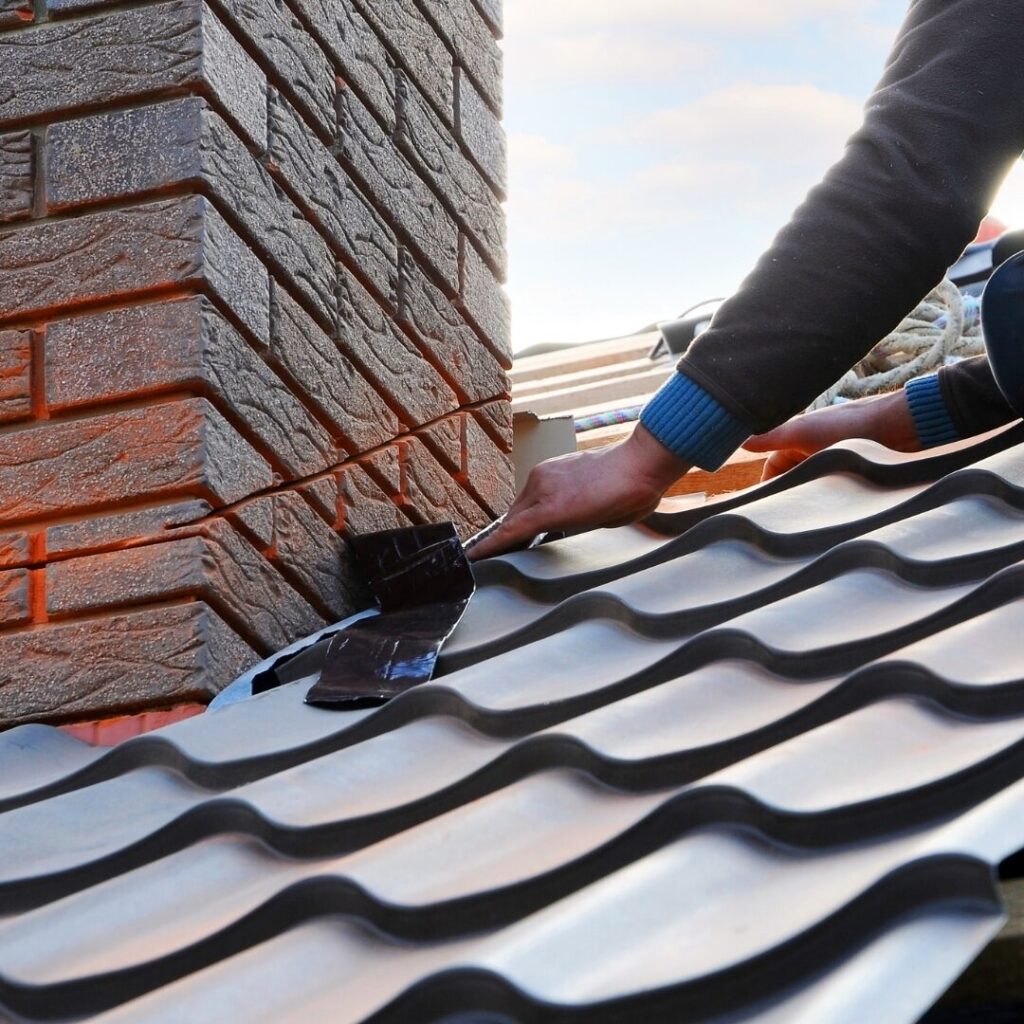
Risk: Flashing separation at a chimney or skylight delivers concentrated water — all of the flow from the roof plane above it — directly into the roof system at a single penetration point. The water volume involved during a heavy rain event is substantial. Localized decay and structural damage occur faster at these penetrations than at distributed tile failures. Chimneys on masonry homes in Dublin also exhibit flashing-to-masonry seal failures as the mortar behind the counter flashing degrades.
We disassemble the failed flashing sequence, clean and prep all surfaces, and reinstall a properly integrated flashing system using step flashing, counter flashing, and appropriate sealant. Where saddle or cricket construction is absent on a wide chimney, we build it — it’s the only permanent solution to the water diversion problem.
Aging Underlayment Beneath Tiles
Clay and concrete tiles routinely last 50 years or more with proper maintenance. The underlayment beneath them — typically 15-lb or 30-lb felt, or a single-ply synthetic — has a service life of 15 to 25 years depending on material, installation quality, and climate exposure. Most tile roofs in Dublin’s older developments are on their second or approaching their third decade. The tile looks fine. The underlayment may not be.
Underlayment failure doesn’t announce itself until it leaks. At that point, the roof has been allowing moisture from dry rot to enter the decking for some time already. A proactive underlayment assessment — conducted during a maintenance visit by lifting selected tiles in vulnerable areas — can identify brittleness, cracking, or delamination before they cause interior damage. When underlayment failure is confirmed in a localized zone, section replacement is possible without a full reroof. When it’s widespread, a full reroof with tile reset is the responsible recommendation — and we’ll tell you that directly rather than let you find out after two more winters.
Related Roofing Services Offered In Dublin, CA
How Our Tile Roof Maintenance Process Works
Service | Connection to Tile Roof Maintenance |
When maintenance uncovers cracked, slipped, or broken tiles, we handle the repair on the same visit or schedule it immediately — no second company needed. | |
Roof Leak Detection | Tile roofs hide leaks well. If you have ceiling stains or attic moisture but no obvious source, we use systematic leak detection to trace the intrusion path and fix it at the source. |
A standalone roof inspection documents your tile roof’s current condition with photos — useful for insurance, HOA compliance, or a pre-sale disclosure package. | |
Clogged gutters are the primary cause of water pooling against fascia and backing up under tile at the eave. We inspect and clean gutters as part of a comprehensive maintenance visit. | |
When underlayment failure is widespread and tiles are at the end of their service life, a full reroof is the honest recommendation. We’ll tell you when you’re there — and when you’re not. |
Every maintenance visit follows the same disciplined sequence. We don’t skip steps to save time, and we don’t start repair work until you’ve seen the findings and approved the scope in writing.
Step 1 | Thorough Roof Tile Inspection | We walk the entire roof, inspecting every tile field, ridge cap, hip cap, and rake edge. We look for slippage, cracking, efflorescence, and surface erosion — and we document every finding with photos before we come down. |
Step 2 | Identify Cracked, Loose, Or Missing Tiles | Every damaged or displaced tile is catalogued by location and failure type. We distinguish between cosmetic surface wear and structural compromise so your repair plan is prioritized correctly — urgent repairs first, elective maintenance in a second phase if preferred. |
Step 3 | Check Flashing And Penetrations | Tile roofs fail at transitions, not in the field. We inspect step flashing, counter flashing, chimney caps, skylight curbs, pipe boot seals, and valley metal for separation, corrosion, or improper installation — the failure points that cause the majority of tile roof leaks in Dublin. |
Step 4 | Evaluate Underlayment Condition | Where tiles are lifted or removed for access, we inspect the underlayment beneath for brittleness, cracking, or active moisture penetration. Underlayment condition determines whether targeted repair is viable or whether a broader scope is the responsible recommendation. |
Step 5 | Provide Honest Repair Plan With Clear Pricing | You receive a written scope of work, itemized by repair type, before any work begins. We separate must-do repairs from recommended preventative items so you can make an informed decision. No pressure. No upselling. Our license number 642517 is on every document we give you. |
Why Dublin Homeowners Choose Wonderlin Roofing
Family-Owned Since 1992 | Grover and Larae Wonderlin have been roofing East Bay homes since the year Dublin was incorporated. When you call, you deal with the owners — not a franchise rep or a subcontractor dispatched from out of the area. |
Licensed, Bonded & Insured — CA 642517 | Our California CSLB license 642517 is active, verifiable at cslb.ca.gov, and covers all tile roofing work. We carry liability and workers’ comp on every job in Dublin — you’re protected. |
Castro Valley-Based, Serving Dublin | We’re headquartered five miles from Dublin’s western edge. We know the tile profiles used in Dublin Ranch, the HOA requirements in Positano, and the permit process at the City of Dublin Building Department. |
30+ Years of Tile Roofing Experience | Clay and concrete tile roofing requires different techniques, tools, and judgment than shingle work. We’ve been doing it since before most of Dublin’s current neighborhoods existed — and we don’t treat tile jobs like shingle jobs. |
Warranty-Backed Workmanship | Every maintenance or repair service carries a written workmanship warranty. If the work we performed fails, we return and correct it at no charge. |
Honest ‘Repair First’ Philosophy | We don’t recommend replacement when maintenance will do. Dublin homeowners who call us for a second opinion regularly find that their roof has years of serviceable life remaining — it just needs the right attention. |
Authority references: California Contractors State License Board (CSLB) · National Association of Home Builders (NAHB)
Local Expertise And Community Understanding
Dublin’s Mediterranean climate means the threats to a tile roof arrive in a predictable pattern — and a maintenance schedule tuned to that pattern prevents the majority of repair scenarios we see. The dry, high-heat summer season desiccates flashing sealants and accelerates the thermal movement that loosens fasteners and opens flashing separations. By October, those openings are ready to admit water. The first concentrated rains of November and December are when most Dublin homeowners discover that something went wrong over the summer — and that it’s been waiting to fail since July.
Dublin’s growth along the Tassajara Road corridor and in communities like Dublin Ranch, Positano, and the newer Wallis Ranch development has brought large numbers of concrete tile roofs into the East Bay’s housing stock over the past 25 years. Many of these roofs are now in the 15-to-22-year range — the window where underlayment inspection becomes genuinely important. HOA requirements in Dublin’s planned communities also often mandate roof maintenance documentation for compliance and resale. We provide written inspection reports and scope-of-work documentation that satisfy HOA requirements directly.
Permits for structural tile roof work in Dublin are processed through the City of Dublin Building Department. For homeowners interested in the energy-efficiency aspects of roofing — including tile’s thermal performance compared to other systems — the U.S. Department of Energy’s roofing guidance provides useful background. We handle all permit applications for work that requires them, and we coordinate inspections so the process doesn’t interrupt your project timeline.
FAQs About Tile Roof Maintenance In Dublin, CA
How Often Should Tile Roofs Be Inspected In Dublin?
We recommend a professional tile roof inspection every two years for roofs under 15 years old, and annually for roofs 15 years and older. Dublin’s concentrated winter rain season means that any flashing separation or tile displacement that developed over summer will be actively admitting water by November. Catching those conditions in September or October — before the rains — is the difference between a $300 maintenance repair and a $4,000 structural one. After any significant wind event or rooftop work by another contractor, an inspection is warranted regardless of the schedule.
Do You Provide Emergency Tile Roof Repair?
Yes. If you have an active leak, exposed decking from displaced tiles, or a storm-damaged roof section, call us at (510) 288-8020 and we prioritize same-day or next-day response throughout Dublin, East Dublin, Dublin Ranch, Positano, and the Tassajara area. Active water intrusion through a tile roof system escalates quickly — we treat it accordingly.
How Long Does Tile Roof Underlayment Last?
Standard felt underlayment on tile roofs has a typical service life of 15 to 20 years under normal Alameda County conditions. Synthetic underlayments installed in the last decade are rated for 25 to 30 years. Actual lifespan varies based on original installation quality, attic ventilation, and climate exposure. The tile above the underlayment often has decades of remaining life when the underlayment beneath it needs attention — which is exactly why proactive inspection matters. Replacing underlayment on a section or zone basis, while resetting existing tiles, is almost always more cost-effective than a full reroof.
Can You Match Existing Roof Tiles?
In most cases, yes — with the practical caveat that exact color match on tiles with significant weathering is difficult. Concrete tile manufacturers maintain extensive product lines, and we work from manufacturer stock to find the closest available match in profile and color. For clay tile, particularly on older Dublin homes with custom or discontinued profiles, we source from specialty roofing suppliers. We photograph proposed replacement tiles alongside existing material before installation so you can approve the match.
Are Your Roofers Licensed In California?
Yes. Wonderlin Roofing holds California CSLB license 642517, which is active, current, and verifiable at cslb.ca.gov. We are licensed for roofing, bonded, and carry full liability and workers’ compensation insurance on every job. Every document we provide — inspection reports, estimates, contracts — includes our license number. You should verify any roofing contractor’s license before allowing them on your roof.
Is Maintenance Cheaper Than Replacement?
Almost always, yes — and significantly so. A proactive tile roof maintenance visit that addresses cracked tiles, reseals flashings, and clears valley debris typically runs $400–$1,200 depending on roof size and findings. A full tile reroof on a Dublin home runs $18,000–$35,000 or more depending on size and tile specification. The goal of regular maintenance is to extend the functional life of your existing tile system by catching the specific failure points that lead to structural damage — the underlayment failures and flashing separations that, if left untreated, make replacement unavoidable before the tile itself is at end of life.
How Soon Can You Schedule An Inspection?
For standard maintenance inspections in Dublin, we typically schedule within 48 hours. For active leaks or storm-related damage, we prioritize same-day or next-day response. Call (510) 288-8020 or reach us at sales@wonderlinroofing.com to confirm current availability. We don’t use a call center — you’ll speak with someone who can put you on the schedule directly.
Contact Wonderlin Roofing today for a professional inspection and protect your home before minor issues turn into major repairs.
Call or Text: (510) 288-8020
Free estimates · Written warranty · Same crew, every visit
Wonderlin Roofing · CA License 642517 · 18812 Lenross Ct, Castro Valley, CA 94546